Capsule House Monsoon Malaysia: Wet-Proof Spec
Monsoon-proofing a capsule house in Malaysia: roof drainage and overflow, wind-driven rain sealing, telling condensation from a leak, and maintenance.
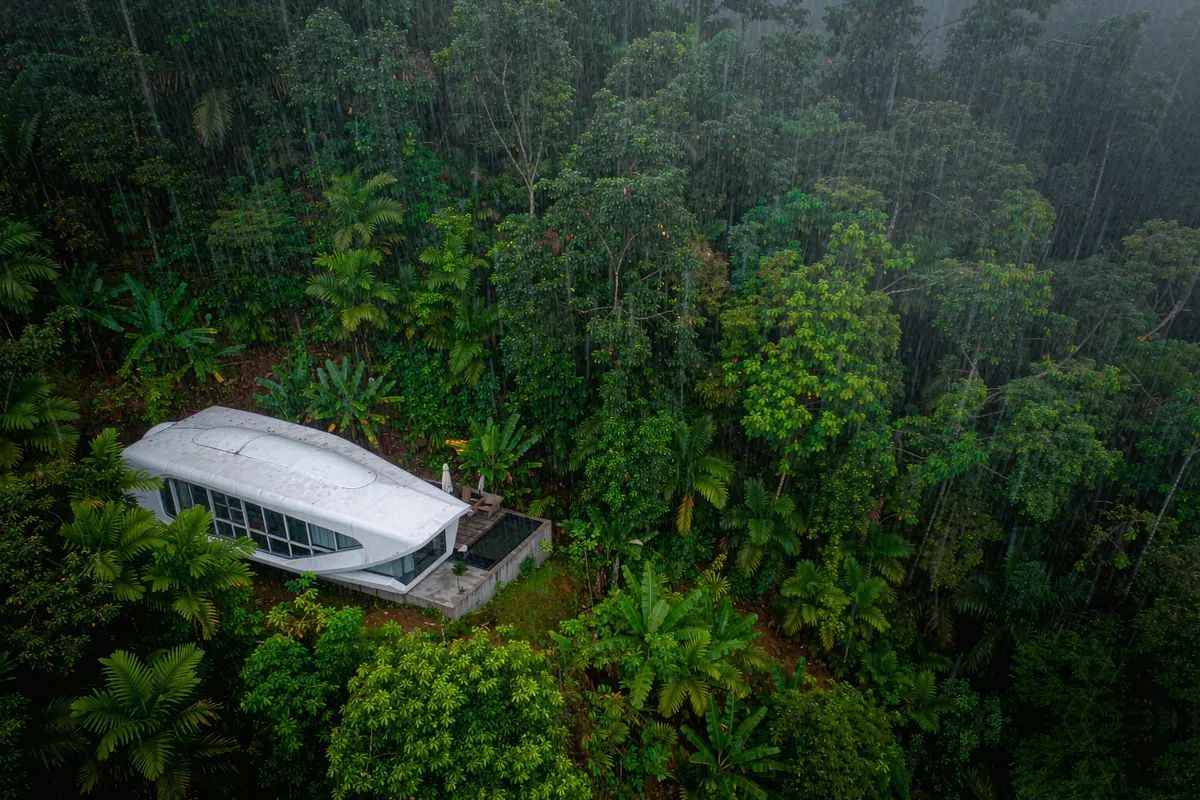
A capsule house survives a Malaysian monsoon on four things: how fast the roof sheds water, how well the envelope resists wind-driven rain, whether the build-up controls condensation, and whether anyone can reach the parts that need checking. Three of the four are decided before the unit ships. This page is the engineering and maintenance view — roof water, sealing, condensation physics and the inspection routine — written for owners and operators of units in Peninsular Malaysia and Sabah and Sarawak. The wider climate and siting picture, including island and coastal exposure, is on our capsule house in Malaysia page.
What the Monsoon Actually Does
Four separate loads arrive together, and they are usually designed for one at a time.
- Volume. Rainfall arrives in short, intense bursts that can exceed the capacity of an undersized gutter in minutes. The failure mode is not leakage through the roof — it is water going over the back of the gutter and down the wall.
- Wind-driven rain. Water is pushed horizontally and upwards, which defeats details that rely on gravity alone: laps, thresholds and unsealed penetrations.
- Sustained humidity. For weeks at a time the air stays near saturation. Anything colder than the dew point will collect water, inside or outside.
- Intermittent sun. Hot sun between storms cycles sealants and coatings thermally, which is how small cracks become leaks over a season rather than a week.

Roof Water: Size It and Give It Two Paths
Ask for the gutter cross-section, the number and position of downpipes, and — the question most buyers forget — whether there is an overflow path. When a downpipe blocks, water needs somewhere to go that is not down the wall and not into the unit. An overflow is cheap at the factory and awkward to add later.
Then look at where the water lands. A downpipe discharging at the base of a unit on sloping tropical ground will undermine the foundation and wash out the access path within one season. Downpipe discharge, surface grading and the site drainage plan have to be designed as one thing. On pier or pad foundations, confirm the splash detail and check after the first heavy storm where the water actually went.
Wind-Driven Rain and the Envelope
Gravity details fail under wind pressure. The places to look, in the order they usually leak:
- Service penetrations. Every hole for power, water, condensate or data is a potential entry. Ask how each penetration is sealed and whether the seal is accessible for re-application.
- Panel joints. Ask what the joint is — a sealed butt joint, a drained and ventilated joint, or a mechanical lap — and what seals it. A joint that depends entirely on sealant will need re-sealing on a cycle.
- Door thresholds. An outward-opening door on a windward elevation with a flat threshold is a common leak. Ask for the threshold detail and the drainage in front of it.
- Glazing edges. Confirm the sealing method and the drainage path at the bottom of the frame. Water that enters a glazing channel should have a way out.
Ask the factory what water test they perform before shipment, and whether you can see the result. A documented test is worth more than a photograph of a finished unit.
Condensation: The Failure People Mistake for a Leak
Water on the inside of the glass on a cool morning is not necessarily a leak. Air holds less moisture as it cools; when warm humid air meets a surface below the dew point, water condenses on it. In a Malaysian context this happens on air-conditioned glass, on cold water pipes, and on the underside of a roof panel at altitude after a clear night.
Three variants matter, and they have different fixes:
| Type | Where you see it | What actually fixes it |
|---|---|---|
| Surface condensation | Inside face of glazing, cold pipework | Warmer surface (better glazing) or lower interior humidity (ventilation, dehumidification) |
| Interstitial condensation | No visible sign until staining or soft finishes appear | Correct vapour control layer position in the build-up — a factory design item |
| Rain penetration | Wet patch after rain, usually at a joint or penetration | Sealing, drainage path, flashing |
Telling the three apart before you commission a repair saves money. Run the unit with the air conditioning off and the ventilation on for a day: if the water disappears, it was condensation. If it tracks a joint and appears after rain, it is water ingress.
Mould: Design First, Cleaning Second
Mould needs moisture, a surface and time. Remove any one and it does not establish. In practice that means cold surfaces kept above dew point where feasible, air movement in wardrobes and behind furniture, mechanical extraction in wet rooms that actually runs, and a between-stays routine that dries the interior rather than sealing it up wet.
Choose interior finishes with this in mind. Absorbent, unsealed surfaces in a wet room or around a glazing reveal will hold moisture and stain. Ask what finishes are used in the wet areas and how they are sealed at the edges.

What to Verify Before Shipment
These are answerable at the factory and expensive to fix at the site:
- Written wall, roof and floor build-up, including the position of any vapour control layer.
- Glazing specification: panes, cavity, frame type, thermal break, and how a damaged unit is replaced.
- Sealing method and material at every penetration, with a statement of maintenance interval.
- Gutter and downpipe sizing, plus the overflow provision.
- Water test procedure and result.
- Ventilation route for wet rooms and the background ventilation path when the unit is closed.
- Electrical standard — Malaysia operates on 230 V / 50 Hz with Type G sockets. Requirements may vary by application, market and applicable standard.
Commissioning in the Wet Season
If your unit lands during the monsoon, treat the first month as an inspection period rather than a finished handover. Walk the unit during heavy rain, not after it: stand inside and look at every joint, penetration and glazing edge. Check the underside where you can reach it. Confirm downpipe discharge is going where the drawing said. Photograph anything that is not right and log it while the snagging window is open.
Haishu delivers units substantially finished so that on-site work is connection and commissioning rather than construction, which shortens this window but does not remove it. The first storm is the best test you will get, so plan to be on site for one.
A Maintenance Calendar That Fits the Climate
| Frequency | Check |
|---|---|
| Monthly in wet season | Clear gutters and downpipes; check discharge path; inspect accessible seals |
| Between guest stays | Run extraction; dry interior; check for staining at glazing reveals and wet-room edges |
| Quarterly | Door and window seals; threshold drainage; underside access points; termite inspection where locally advised |
| Before monsoon | Full envelope walk, sealant condition, overflow paths clear, spares on hand |
| After the first major storm | Re-walk every joint and penetration; confirm site grading still sheds away from the unit |
What to Send Us
Send your site location, altitude, exposure and access conditions, the configuration you are considering, and your intended opening date. We will tell you which envelope and drainage lines we would strengthen for a monsoon site and what has to be resolved locally. We publish no price figures — they depend on configuration, route, market conditions and date, and only your suppliers can establish them. See the Galactic A series and send details through the contact page.
More from the Blog

Capsule Home Cost Guide: What You Really Pay in 2026
EXW, shipping, install and the hidden line items — a transparent breakdown of total landed cost.
Read article →
How to Install a Capsule Home in 3 Days: A Step-by-Step Guide
From site prep to first guest — the exact sequence our install crews follow on every deployment.
Read article →
Real Owners, Real Numbers: Success Stories
How a lakeside resort, a Spanish glamping site and a Singapore dealer hit their targets.
Read stories →Talk to the Factory
Ready to Ride the 2026 Wave?
Get the latest catalog, pricing tiers and a layout sketch for your land — straight from the engineering team.